|
The simple fact of wanting to make films in this country is a political
act.
It is only here that I feel myself...I couldn't create elsewhere -
Claude Jutra

"Pegi Nichol - Something Dancing About Her"
On Sunday the 13th of February 2005 at the National Gallery of Canada,
"Pegi Nicol - Something
Dancing About Her" received its world premiere. The screening was
timed to coincide with the opening of an exhibition of paintings by Pegi
Nicol MacLeod at the Carleton University Art Gallery, curated by
Laura Brandon,
who was also launching the publication of her biography of the painter.
Ottawa filmmaker Michael Ostroff directed the NFB production. In spite
of limited publicity, it played to a packed house and received a
standing ovation. A second screening at Carleton University a few weeks
later also packed the house. Who is Pegi Nicol MacLeod, some of us
might ask? But more to the moment, who is Michael Ostroff?
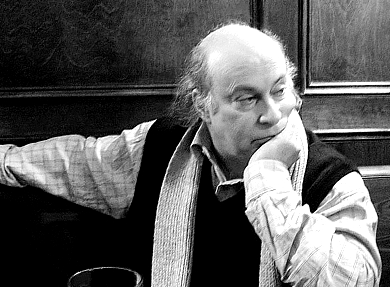
©Photo
by Ken Bole
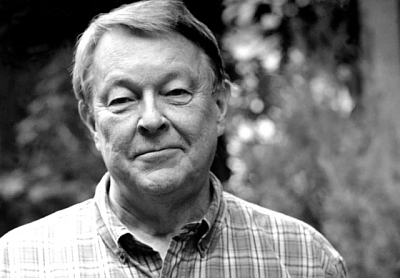
Michael Ostroff
Born in 1950 in Montreal, Michael Ostroff studied history and political
science at Sir George Williams University, now part of Concordia. By
also taking a film course, he was able to make his first short, the
quality of which got him into York University for a special two-year
programme . In those days York's distinguished faculty included
Jay
Leyda and
James Beveridge. "But the person that had the most influence on me,"
Ostroff recalls, "was clearly Beveridge who had an infectious love of
Canadian film. And in 1971, you could count the number of filmmakers on
your two hands. 'Goin'
Down the Road' by Don Shebib had just opened and everybody was
thrilled. Could we actually make films in Canada? Is this
now a possibility?"

Goin' Down the Road
From the outset, Ostroff knew that he wanted to make political films. In
1973, he began a three-year stint at
Crawley Films in Ottawa, after
which he moved to Ireland where he found a dynamic artistic
community which included
Neil Jordan and Jim
Sheridan, who were about to make their first films. This sense of
community provided Ostroff with a model for what he wanted to achieve
when he returned to Ottawa. He found it, in part, through making
advocacy videos for councils and unions, most consistently for the
Canadian Union of Postal Workers. Not only did these works keep the wolf
from the door, but they allowed him to hone his skills as a filmmaker,
gradually developing a
distinctly Ostroffian style. While the elements of this style all
operate simultaneously in most of the films, four recurring strategies
of Ostroff can be singled out for special investigation.

Crawley Films
Fairmont Ave.
Ottawa
Advocacy Films
First, Ostroff's films are all about communities. "Wakefield Mill"
(1984), made for the National Capital Commission, is about the rise and
fall of two 19th century entrepreneurs who achieved success in a farming
and logging community just north of Ottawa before they were brought down
by changing economic times. Like
"City of Gold"
(1957), "Wakefield Mill" consists largely of still photographs,
all of them hand-tinted, plus archival footage of early pioneer days
that he knew about through working at Crawley's. Helped by the music of
Ian Tamblyn, the film beautifully evokes the 19th century's faith in the
value of local enterprise before big city take-overs rendered infeasible
such individual initiatives.
Similarly, in "By the Skin of our Teeth" (1980), at that time working
for the Ottawa Tenants Council with Brenda Longfellow as narrating
presence, Ostroff explores the community of single moms
trying to raise their children on the pittance provided by mothers'
allowance. One especially sad young mother of four confesses that she
was reduced to fraud, simply to have money to buy her kids
Christmas presents. Although a simple piece and highly dependent on
talking heads, the film was enormously successful. "By the Skin of our
Teeth" was very effective," Ostroff remembers, "because the interviews
managed to capture some of the emotion of the women. It was a static
piece because it was a very early video production, and in those days
the cameras were so primitive and the editing facilities even worse.
Cutaways were virtually impossible. But despite all those technical
problems, it did very well. It was picked up by DEC (Development
Education Centre), and there were screenings all across the country."
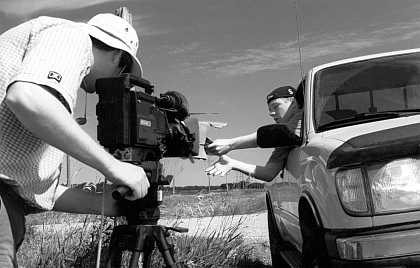
"Basic Rights"
Second, the films all
possess a dialogic structure. Different elements in the films speak to
one another in dramatic, sometimes conflicting ways. For instance,
in "Basic
Rights" (2000), Ostroff
explores the community of rural postal workers, most of them female, and
their mistreatment by Canada Post who designated them freelance
entrepreneurs so they were not allowed to unionize, receive benefits, or
charge expenses. For this film, Ostroff devised an ingenious
system of radios and wireless mikes, which allowed the crew to shoot
from a separate automobile while interviewing the subjects as they went
about their work. This film is not at all static. We both hear
their grievances and see the beautiful landscapes of the Maritimes,
Quebec, and Manitoba. These images dialogue with written
statistics of their economic plight and the rush of expenses at the gas
pumps as they fill up their tanks.
Third, more often than not, there is a
metaphoric resonance ot cutaways. As Ostroff notes, "The context is
absolutely crucial in all the stuff I do. I really try to bring in some
images or ideas that will get people to think beyond the narrowness of
the story."
In "Bridging the River of Silence" (1991), a finely evocative film about
Renfrew County's (Ontario, Canada) response to wife abuse, dexterously
captured by the unobtrusive camera of
Joan Hutton, there are recurring shots that might suggest domestic
bliss - a windmill, a cat, an abandoned stove. These images, however,
contrast forcefully with the stories told by the women of the violence
they suffer from their (generally drunken) men. There are also
repeated shots of a communications tower, suggesting a world in which,
within these marriages, communication has broken down.

"Bridging the River of Silence
Undoubtedly, the finest of all the union films is
"Many
Rivers to Cross" (1999). Taking two years to make and lasting 95
minutes, it registers the protracted and most dramatic negotiations
between the Canadian Union of Postal Workers and the uptight bureaucrats
representing Canada Post. The film is blessed by the presence of
Philippe Arbour, the pony-tailed chief negotiator of the union who
possesses the magnetic characteristics of a star.
All the union people
dress casually and seem to be having fun, as if to relieve the tension
of the on-going negotiations, unlike the bureaucrats who never smile in
their suits and ties. There is a wonderful scene of the workers
demonstrating outside in Hull, Quebec where the negotiations are taking
place. Across the river we see the parliament buildings, which, of
course, represent the site of ultimate authority.
River imagery recurs
throughout the film, providing a context of the negotiations taking
place. Not only do the postal workers talk, metaphorically, of having to
cross a river, but also throughout this film there are cutaways of the
mighty Ottawa River with water surging through a variety of dams. These
recurring shots suggest both power and protection - keeping the two
sides separate from one another.
Unfortunately, because
of complicated legal negotiations, the film never received the exposure
it deserves; but it is - amazingly, considering the subject matter - a
film of Shakespearean proportions. It changes the way we think about
such supposedly utilitarian films.
Finally, the fourth
strategy concerns the collage of dissolves which often appear at the
opening of Ostroff's films. Traditionally, dissolves accelerate
time, but Ostroff uses them
knowingly to suggest a poetic fusion of elements to come: "I like to
have something at the beginning that says to the audience that this
video is really different. There's a certain level of thought that's
gone into this production, and I'm hoping that you bring a certain level
to it as well. Most of the bigger pieces have something at the front,
some kind of preface that tries to shape the entire documentary." These
sequences serve as little fanfares that warn the viewers that they have
to stay awake.?
Of course there are other films and other stylistic strategies,
including Ostroff's ability to combine
the immediacy of cinéma vérité with the authority of more formal
strategies. But let's consider his more public films, which reach less
inwards to the local politics of advocacy groups than outwards to the
more public politics of the production of art.
The Public Films
Designed for television,
"Speaking of
Movies" (1994) is a tribute to the pioneering work of
Gordon
Sparling.
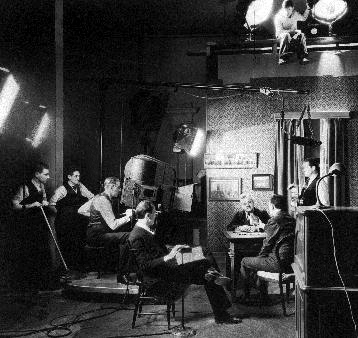
"Speaking of Movies"
Brought back from New York to work for Associated Screen News (ASN) in
Montreal in the 1930s, Sparling had one overwhelming desire: he wanted
to establish a Canadian feature film industry. This was not to be;
but working through ASN, he managed to produce a number of "Screen
Cameos" - ten to 20-minute shorts which represented the only creative
filmmaking in Canada at the time.
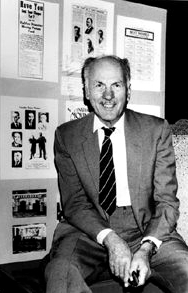
Courtesy:
Toronto International Film Festival Group
Gordon Sparling, 1978
Already in his 90s when Ostroff was
shooting his documentary, Sparling is first seen operating the clapper
board for the beginning of the film, after which the opening credits ape
the style of Sparling's cameos, including the soundtrack for
"Rhapsody in Two Languages" (1934). Throughout this tribute
there is everywhere a dialogue between the past and the present, with
Sparling watching his cameos on a television monitor.
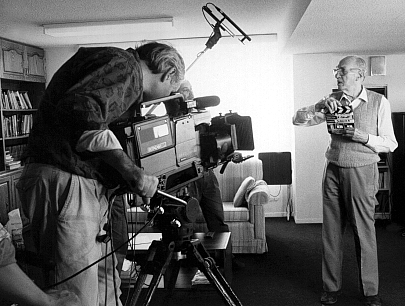
"Speaking of Movies"
Featuring the orchestra
of
Horace Lapp, "Music from the Stars" (1938) is offered as Canada's
first Musical; and "Shadow River" (1933), based in part on a poem by the
Métis writer, Pauline
Johnson, intercuts nightclub scenes of British-speaking sophisticates
with strikingly beautiful representations of the Canadian landscape as
one of the women recites the poem. Corny though these films may
seem today, they do register an achievement for their time and then, as
now, encounter an ultimate blockage.
"You can see in "Music from the Stars," Michael explains, "when they
finally got a sound stage in Montreal, the shooting is black & white
glorious. You could see that with the crew he had around him,
Sparling could have produced a feature film. They may have had
difficulty with the talent, with the acting; but technically they had
the ability to do it. But certainly his career aspirations were limited
by the cultural domination of the Americans."
Had Sparling got his way during this time of the Great Depression, he
would have created an escapist cinema of entertainment in the manner of
Busby Berkely.
Nevertheless, as Laurier LaPierre assures us in the commentary, the work
of Gordon Sparling represented "a step forward to Canadian Nationhood."

Budge Crawley
"Budge: The One True Happiness of F. R. "Budge" Crawley" (2002)
was also designed for television. Ostroff begins this film to stunning
effect with the crucial sequence taken from
"The Man Who Skied Down
Everest" (1975) in which a Japanese athlete attempts to ski
down the highest mountain in the world. He failed, of course, and slid
most of the way, which is why the Japanese didn't care to finish the
film. But Budge purchased the footage, let his wife, Judith Crawley,
write it, and managed to win an Academy Award for which, during his
acceptance speech, he thanked nobody. "A sort of grand fiasco," Don
Franks explains in the commentary, "that was Budge - a crafty
opportunist to some, a mischievous hero to others, striving to create a
Canadian cinema with almost no acclaim. But the Everest film gained him
the first Academy Award for a Canadian feature-length film."

"The Man Who Skied Down Everest"
With many testimonials from the people who worked with him, Ostroff
superimposes shots of Budge and his crew over scenes of the projects
being filmed, once again relating the present to the past. Yet for all
his aspirations and, certainly, his courage, Budge's most ambitious
projects were, in fact, fiascos. He less skied through the industry he
helped to create than slid through it.
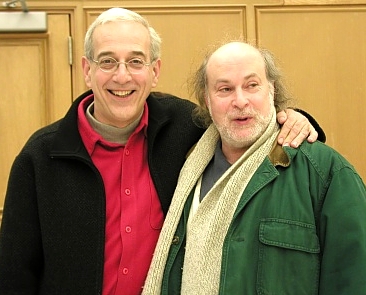
©Photo by
Lois Siegel
Jack Horwitz
Government Projects Manager National Film
Board of Canada
Michael Ostroff,
Filmmaker
at the opening of
"Budge: The One True Happiness of F. R. "Budge" Crawley"
National Archives of Canada
Prior to "Budge," Sound Venture Productions in Ottawa had
commissioned "Canvas of War: The Art of World War Two" (2000). The
challenge for Ostroff with this film was to organize the presentation of
a
lot of different artists. He invited Seaton Findlay to help him: "Seaton
and I worked on it to try to find a story because there was no story.
There was hardly any thread to connect one artist to the other, except
for the fact that they were young Canadian artists going over to portray
the war."
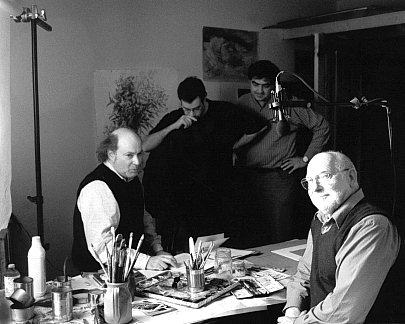
"Canvas of War: The Art of World War Two"
They adopted basically a chronological sequence linked to the different
stages of the European war, but with a cunning procedure: the different
stages of the conflict were punctuated by inter-titles, as
Ostroff had done before; but the printed words anticipated statements
that the various interviewees used, thus linking the characters to
the titles in, arguably, a musical manner.
Many artists are interviewed and others evoked, including Pegi Nicol.
Molly and
Bruno Bobak are the
most eloquent, both speaking with elegance and wit. Paradoxically, as
one might say of the
paintings themselves, the film is beautiful both in its visual style and
through its sensitivity to the subject of paintings - this time dealing
with a little known Ottawa painter, Pegi Nicol MacLeod.
Five years in the making, "Pegi Nicol - Something Dancing About Her"
represents the culmination of everything that Ostroff has achieved so
far. "Pegi Nicol" tells the story of an artist , as both the
Sparking and the Crawley films had done, but with all the stylistic
strategies that had so animated the advocacy films. The Bobaks actually
put him onto the project, especially Molly, who even found money for the
initial research.
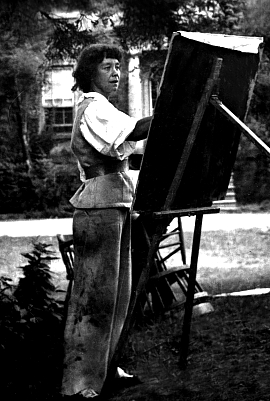
Photo by Madge Smith
©Provincial
Archives of New Brunswick
Pegi Nicol
Having access to Laura
Brandon's papers, Ostroff devised a series of chapters which enabled him
to search for the most appropriate images. "Because I had access to the
transcripts and the letters," he comments, "I had a list of scenes in my
mind of what could be used in terms of the transcripts and the letters.
But in terms of matching the images with the text, that's the whole
basis of this style of filmmaking."
Indeed, the precise matching of image and comment is one of the film's
great accomplishments. When we hear her writing to her friend Marian
about her abortion, we have a shot of a woman walking through a
blustering day, a black hat pulled over her eyes. When Pegi is sent out
to British Columbia to paint the natives, as we hear her explain that
they didn't like the white invaders, there is an accusational shot of a
native woman walking past the camera. And as part of the opening
montage, we see a vat of red paint being pulled into the screen, the
toxicity of which will eventually kill her.
Initially, the film was
planned to contain dramatic re-enactments, but when the budget couldn't
afford them, Ostroff personally rewrote the script to deal with the
absence. This proved to be an inspired decision bestowing on the
film a ghostly dimension. As we see photographs and hear voices, always
in dialogue with the paintings and aided, at times, by the haunting
music of Ian Tamblyn, we get a strong sense of the presence of Pegi's
life and work , even though, in terms of moving images or of her actual
voice, she is absent from the film.
Finally, the film gains
additional authority by its serial construction. An image is established
within a particular context and then, after a time, it appears again
within a different context - then again and then again, as the
contexts shift and change. These recurring images - whether photographs
or paintings - act like leitmotifs in music, doubly important for this
painter's work which, in itself, is musical in design. These
recapitulations guide the spectator's journey though this presentation,
in black & white and colour, of the life of Pegi Nicol and of her search
for a community that would receive her art.
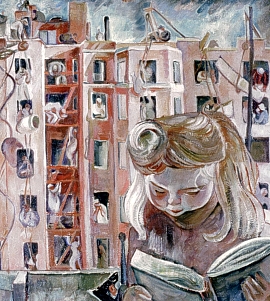
Courtesy: Hart House, University of
Toronto.
Painting by
Pegi Nicol
"Jane Reading"
1948
Although modest in range, at the
level of craft, the films of Michael Ostroff represent an extraordinary
achievement. His early work brings to his utilitarian subjects not only
the authenticity of lived lives, but also the authority of poetry. His
later films, more poetic in their subject matter, often display a
musical organization which contests the historical simplicities of
linear narrative. Ostroff's films are about the search for
community through unions among artists or social advocates, in tandem
with a search for wider social acceptance.
Because these quests parallel what
many people experience in their day-to-day lives, the films of Michael
Ostroff achieve a universal appeal. They ought to be better known.
|